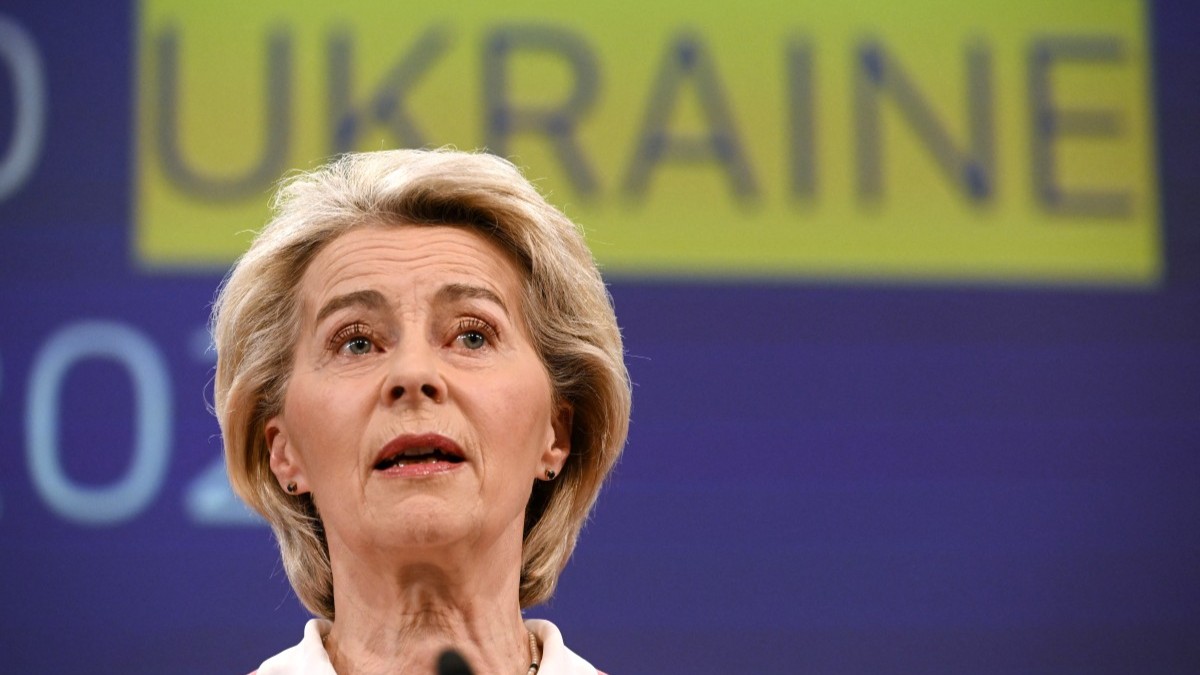
European Commission President Ursula von der Leyen speaks during a press conference to present a financial support package for Ukraine for 2026–2027 at the EU headquarters in Brussels on January 14, 2026.
Nicolas Tucat / AFP
According to the latest findings of Hungarian think tank Századvég’s Europe Project, most Europeans do not support Ukraine joining the European Union through an accelerated accession process that bypasses established membership criteria. While the European Commission is increasingly discussing the possibility of admitting Ukraine as early as 2027 under a fast-tracked procedure, public opinion across the EU clearly moves in the opposite direction.
Survey data show that 75% of respondents do not support accession before the required conditions are fulfilled.
One of the most prominent sources of resistance relates to agriculture and food safety. A majority of respondents express concern about the impact Ukraine’s accession could have on EU farmers, while more than half fear risks to food safety. This is especially warranted after Commission President Ursula von der Leyen signed off on the Mercosur deal, despite the vehement protests from farmers and the governments of several member states across Europe.
Security considerations are another decisive factor shaping public skepticism. More than half of respondents believe that wars and their consequences increase regional security risks, particularly for neighboring countries.
Economic consequences also weigh heavily on public opinion. A majority of Europeans are concerned that Ukraine’s membership would reduce the development funds available to existing member states.
These concerns translate directly into attitudes toward enlargement. Only a small minority of Europeans support immediate accession. Only 18% would support Ukraine’s immediate accession, while 43% insist on the traditional, performance-based enlargement process, and 32% reject Ukraine’s accession altogether.
According to Balázs Orbán, the political director of the Hungarian prime minister, the survey results constitute a “clear message to Brussels.” Orbán stated on X that “pushing Ukraine’s EU accession cannot move forward against the clear will of European citizens.”
📊🇪🇺🇺🇦 While the @EU_Commission would admit Ukraine to the European Union as early as 2027 under a fast-tracked procedure, a recent Europe Project survey shows that a clear majority of European citizens oppose this approach: 7️⃣5️⃣% of respondents do not support accession before… pic.twitter.com/goI6SVPatG
— Balázs Orbán (@BalazsOrban_HU) January 28, 2026
Despite the adverse public opinion, momentum in Brussels has shifted toward accelerating Ukraine’s path to membership. Internal European Commission documents and debates at the latest European Council point to a fast-track accession process potentially concluding as early as 2027, closely linked to Ukraine’s post-war economic reconstruction.
Claims from Kyiv that Ukraine will be technically ready for EU membership by 2027 sit uneasily with the current reality. The country remains at war, with parts of its territory occupied, an economy sustained largely by external aid, and institutions under extreme pressure. Corruption continues to be acknowledged as a systemic problem, with reforms unevenly enforced and judicial independence fragile. In previous enlargement rounds, candidate countries were required to demonstrate sustained institutional stability over many years, a standard that now appears increasingly negotiable.